website-logo

Specification

  • Voltage rating: 60 V DC
  • Voltage accuracy: ±0.1 V at 60 V
  • Current accuracy: ±0.5% from 1 to 500 mA
  • Maximum current protection: 500 mA per channel
  • Temperature range: up to 90 °C
  • Temperature accuracy: ±1 °C at 20–25 °C
  • Channels: 12 (parallel testing)
  • Data logging: Automatic every 30 minutes with charge calculation
  • Connectivity: Serial PC interface / USB
  • Power supply: 180–220 V AC, 50 Hz

Accessories and Spares/Consumables

Type Product Name Product Code Standard Code
NA

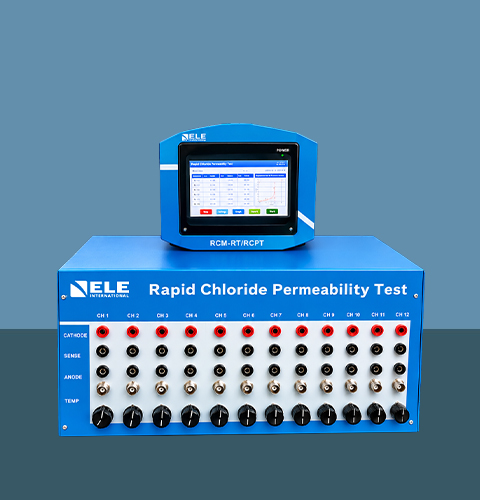
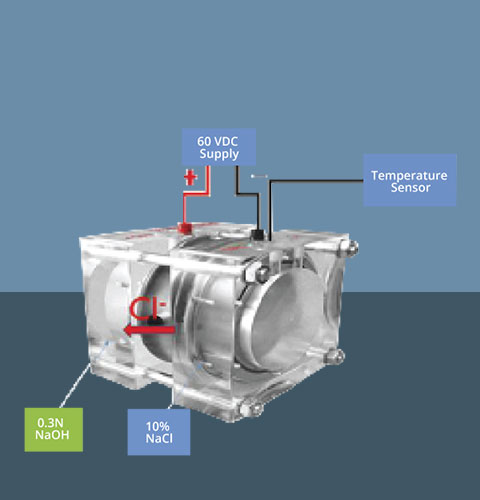
The ELE Rapid Chloride Permeability Test (RCPT) system provides a fast, quantitative assessment of concrete’s ability to resist chloride ion penetration. A saturated concrete disc (typically 100 mm diameter × 50 mm thick) is clamped in a test cell with sodium chloride solution on one side and sodium hydroxide solution on the other. A 60 V DC potential is applied across the specimen for 6 hours, and the total charge passed (coulombs) is used as an indicator of chloride penetrability and long-term durability. 

RCPT Brochure

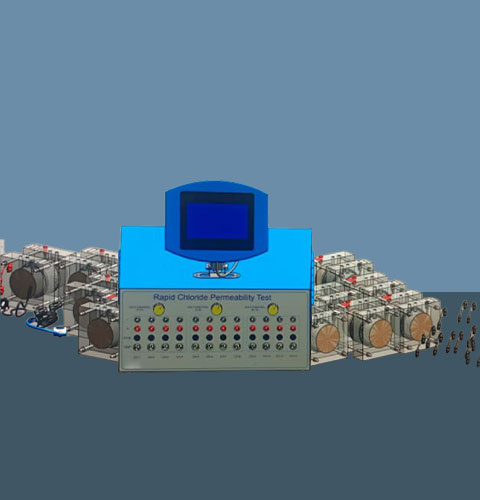
The bench-top unit offers 12 parallel channels, allowing multiple specimens to be tested simultaneously with automated current logging, charge calculation and data export, making it ideal for routine durability testing and project QA/QC in concrete laboratories. 

Key features

  • • Measures chloride ion penetrability of concrete using a 60 V DC electric field

  • 12-channel testing unit for simultaneous testing of multiple specimens

  • • Automatic current logging every 30 minutes with charge computation to ASTM C1202

  • • Short-circuit / over-current protection on each channel

  • • Compact, user-friendly interface; Windows 11–compatible PC connection

Software features 

  • Real-time graphical plotting: Current (A) vs Time (min) for each channel
  • Independent report generation for every testing channel
  • Export of test data to Excel-compatible formats
  • Continuous test monitoring and logging for efficient data analysis and audit traceability

Applications 

  • Evaluation of concrete durability in chloride-rich environments (marine exposure, de-icing salts, coastal infrastructure)
  • Quality assurance and quality control of concrete mixes for low permeability
  • Service-life prediction of reinforced concrete structures
  • Performance-based assessment of chloride resistance for specifications and design checks

Benefits to users 

  • Fast, repeatable testing procedure with clear numerical output
  • Enables more informed maintenance and durability planning for critical structures
  • Essential tool for concrete exposed to aggressive environments
  • Meets international testing requirements and supports accredited laboratory workflows

Permeability classification 

  • > 4000 coulombs: High permeability (e.g. high w/c > 0.5)
  • 2000–4000 coulombs: Moderate permeability (w/c ≈ 0.40–0.50)
  • 1000–2000 coulombs: Low permeability (w/c < 0.40)
  • 100–1000 coulombs: Very low permeability (e.g. latex-modified concrete)
  • < 100 coulombs: Negligible permeability (e.g. polymer concrete)
Request Quote